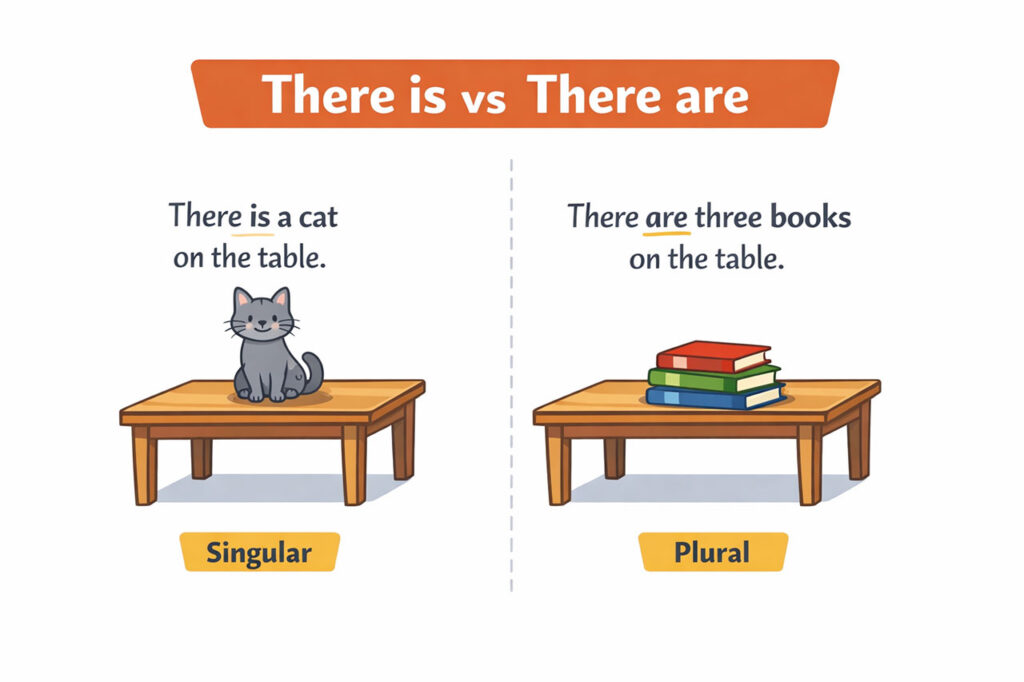
There is vs there are to jedna z podstawowych konstrukcji w języku angielskim, używana do opisywania tego, co znajduje się w danym miejscu. Różnica między tymi formami zależy od liczby rzeczownika.
There is stosujemy w liczbie pojedynczej, natomiast there are w liczbie mnogiej.
Jeśli chcesz poznać więcej podobnych zagadnień, zobacz również najczęstsze różnice w języku angielskim.
Podstawowa zasada
- There is → liczba pojedyncza (jest)
- There are → liczba mnoga (są)
There is a cat on the table.
There are three books on the table.
Konstrukcja ta opiera się na czasowniku to be.
Budowa zdań
Zdanie twierdzące:
There + is + rzeczownik (l. poj.)
There + are + rzeczownik (l. mn.)
There is a chair in the room.
There are two windows in the room.
Przeczenia
Przeczenia tworzymy przez dodanie not.
There isn’t a cat on the table.
There aren’t any books on the shelf.
Często używamy tutaj konstrukcji some i any.
Pytania
Pytania tworzymy przez przestawienie czasownika:
Is there a cat on the table?
Are there any books on the shelf?
Przykłady użycia konstrukcji
Konstrukcji tych używamy bardzo często przy opisywaniu miejsca – pokoju, domu lub miasta.
Zobacz także opis pokoju po angielsku.
There is a bed next to the window.
There are four chairs in the kitchen.
There is a small park near my house.
Najczęstsze błędy
- ❌ There is two books
- ✔ There are two books
- ❌ There are a cat
- ✔ There is a cat
FAQ – konstrukcja there is / there are
Kiedy używamy there is, a kiedy there are?
There is stosujemy w liczbie pojedynczej, a there are w liczbie mnogiej.
Jaka jest różnica między there is a there are?
Różnica polega na liczbie rzeczownika – jedna forma dotyczy jednej rzeczy, druga wielu.
Czy można używać there is z some i any?
Tak, np. There is some milk lub There isn’t any milk.
Jak tworzyć pytania?
Wystarczy przestawić is lub are na początek zdania.
Podsumowanie
Różnica między there is i there are polega na liczbie rzeczownika. There is używamy w liczbie pojedynczej, a there are w liczbie mnogiej.
Zobacz także:
Ćwiczenie
Uzupełnij zdania.